Vaccines are a powerful tool in preventing disease and reducing the spread of infectious diseases. Basic vaccinations are important for everyone to build immunity and reduce the risk of serious diseases. This article will help you understand the importance of basic vaccinations, details on what vaccines are needed at different ages, and recommendations for the best prevention of disease.
What are Basic Vaccines?
Basic vaccines refer to vaccines that are recommended to prevent common and serious diseases, which are mostly included in the national vaccination program. These vaccines help stimulate the body’s immune system to create antibodies to fight against pathogens that may enter in the future.
The importance of Basic Vaccines
- Prevent serious diseases Vaccines help reduce the risk of infection and the spread of disease in the community.
- Promote herd immunity. When most of the population is vaccinated, it helps protect those who cannot be vaccinated, such as infants or those with compromised immune systems.
- Reduce the mortality rate and economic burden. Vaccines help reduce the cost of treatment and the burden caused by infectious diseases.
- Promote long-term health. Vaccination helps prevent diseases that may affect health in the long term, such as chronic infections.
Important Basic Vaccines at Every Age
1.Childhood Vaccines
In childhood, the immune system is not yet strong. Basic vaccination at this age helps prevent serious diseases that can affect children’s development, such as:
- Tuberculosis Vaccine (BCG) protects against tuberculosis, especially in children at risk of developing tuberculosis meningitis.
- Hepatitis B Vaccine protects against hepatitis B. That can lead to cirrhosis and liver cancer.
- Diphtheria, tetanus, and pertussis (DTP) vaccine protects against respiratory and neurological diseases.
- Polio vaccine (OPV/IPV) protects against polio, which causes permanent paralysis.
- Measles, mumps, and rubella (MMR) vaccine protects against infectious diseases that can affect the brain, pregnancy, and hearing.
2.Vaccines for teenagers
Adolescence is a time when the immune system still needs to be strengthened. Recommended vaccines during this time include:
- HPV vaccine protects against HPV infections that are associated with cervical cancer and genital warts.
- Hepatitis A vaccine protects against infections that cause inflammation of the liver.
- Flu vaccine is recommended annually to protect against new strains of influenza.
- Tetanus, diphtheria, and pertussis (Tdap) vaccine for adults helps boost the immune system.
3.Vaccines for adults
Adults still need to get certain vaccines to protect against diseases that may be caused by everyday contact with germs.
- Influenza vaccine should be given every year, especially for the elderly and those with underlying diseases.
- Pneumococcal vaccine is recommended for the elderly and those with compromised immune systems to reduce the risk of pneumonia and meningitis.
- Shingles vaccine for those aged 50 and over to prevent shingles and nerve pain.
- Hepatitis A & B vaccines to reduce the risk of liver infection.
4.Vaccines for pregnant women
Pregnant women should receive certain vaccines to protect both the mother and the fetus, such as:
- Tetanus, diphtheria, and pertussis (Tdap) vaccine to prevent the spread of infection to newborns.
- Flu vaccine to reduce the risk of complications during pregnancy.
Consequences of not getting basic vaccinations
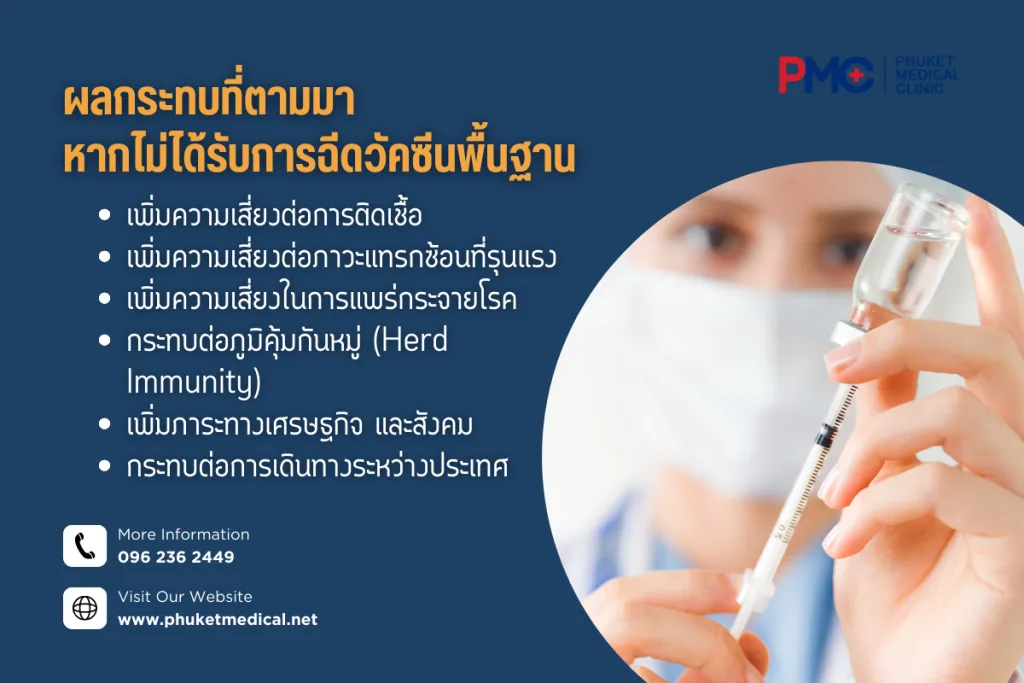
Neglecting or not getting basic vaccinations on schedule can have long-term health effects, both in terms of disease prevention and community transmission, as follows:
- Increased risk of infection
- The body does not have immunity to vaccine-preventable diseases, such as influenza, measles, diphtheria, and polio.
- The risk of serious diseases, such as tuberculosis or hepatitis B, increases.
- Increased risk of severe complications
- Vaccine-preventable diseases often have severe consequences, such as rubella brain infection or polio paralysis.
- For people with underlying diseases or weakened immunity, not getting vaccinated increases the risk of life-threatening complications.
- Increased risk of disease transmission Not getting vaccinated not only increases the risk to your own health, but also increases the chance of spreading the disease to others, especially at-risk groups, such as infants, the elderly, and immunocompromised patients.
- Affecting herd immunity When a large number of people are not vaccinated, herd immunity in the community decreases, resulting in previously controlled diseases having a chance to spread again.
- Increased economic and social burdens Illness from vaccine-preventable diseases results in increased medical expenses and may affect the ability to work or study.
- Affecting international travel Some countries have regulations that require certain vaccinations before travel. Failure to receive a vaccination may result in travel restrictions.
Preparation before vaccination
- Consult a doctor, inform them of any allergies to medications, vaccines, or underlying diseases.
- Check the vaccination schedule, check if all the vaccines required for that age have been received.
- Take care of your health. If you have a fever or are sick, you should postpone the vaccination until you are well.
Get vaccinated at Phuket Medical Clinic, Laguna Branch
Phuket Medical Clinic, Laguna Branch is committed to providing comprehensive vaccination services, with the following highlights:
- Various vaccines, providing basic vaccines such as influenza vaccine, HPV vaccine, hepatitis B vaccine, and specialized vaccines according to the needs of each age group.
- A team of expert doctors, providing advice from doctors with experience in healthcare and disease prevention through vaccination.
- Private management, providing pre-vaccination health check-ups and detailed consultations to suit the patient’s physical condition.
- Modern medical equipment, using equipment certified by international standards, ensuring safety.
- Convenience, located in an easily accessible area, with advance booking service to reduce waiting times.
Whether you need a vaccination to prevent common diseases or travel internationally, Phuket Medical Clinic, Laguna Branch is ready to take care of your health closely!
Read more articles
- How necessary are vaccines? Find out what you should know
- Common diseases that should not be overlooked, know the warning signs and prevention methods for good health
Contact Channels
Laguna Branch
- Phuket Medical Clinic, Laguna Branch is located at 58/1, Cherngtalay Subdistrict, Thalang District, Phuket Province 83100
- Open every day, Monday – Sunday, 09.00 – 22.00 hrs.
- Inquire via Line id. @pmcphuket (with @)
- Contact number 096 236 2449
- Clinic map https://maps.app.goo.gl/SXaeLrSU9Lx47YPH6
- Book an appointment online https://pmclaguna.youcanbook.me
Branch in the city
- Phuket Medical Clinic, Phuket City Branch is located at 41/7-41/8, Talat Nuea Subdistrict, Mueang Phuket District, Phuket Province 83000
- Open every day, Monday – Sunday, 09.00 – 22.00 hrs.
- Inquire via Line id. @pmcphuket (with @)
- Contact number 096 228 2449
- Clinic map https://maps.app.goo.gl/yeU9qNArGg3qdwZw9
- Book an appointment online https://phuketmedicalclinic.youcanbook.me
Boat Lagoon Branch
- Phuket Medical Clinic Boat Lagoon Branch is located at 20/96. Moo 2, Thepkrasattri Rd., Koh Kaew Subdistrict, Mueang Phuket District, Phuket Province 83000
- Open every day, Monday – Sunday, 10.00 – 18.00 hrs.
- Inquire via Line ID. @pmcphuket (with @)
- Contact number 096 696 2449
- Clinic map https://maps.app.goo.gl/HbqfUKMEHXuKwan96
- Book an appointment online https://pmctown.youcanbook.me
Basic vaccines are the key to preventing diseases and building immunity for the body at all ages. Following the recommended vaccination program and taking care of your health properly reduces the risk of serious diseases and supports long-term good health. Choosing to get vaccinated at a reliable medical facility with advice from a medical professional is another important step to help ensure your health and that of your loved ones!
Reference
- Centers for Disease Control and Prevention (CDC). “Immunization Basics.” Comprehensive guidelines and benefits of vaccines. [ออนไลน์] เข้าถึงได้จาก https://www.cdc.gov/vaccines/vac-gen/imz-basics.htm
- World Health Organization (WHO). “Vaccines and immunization.” Global insights into vaccine importance and coverage. [ออนไลน์] เข้าถึงได้จาก https://www.who.int/health-topics/vaccines-and-immunizatio
- Mayo Clinic. “Childhood vaccines: What they are and why your child needs them.” Insights into essential vaccines for children. [ออนไลน์] เข้าถึงได้จาก https://www.mayoclinic.org/diseases-conditions/vaccines
- กระทรวงสาธารณสุขแห่งประเทศไทย. “โปรแกรมวัคซีนแห่งชาติ.” ข้อมูลเกี่ยวกับวัคซีนพื้นฐานในประเทศไทย. [ออนไลน์] เข้าถึงได้จาก http://www.moph.go.th
- สถาบันวัคซีนแห่งชาติ. “วัคซีนเพื่อการป้องกันโรคในประเทศไทย.” [ออนไลน์] เข้าถึงได้จาก https://nvi.go.th