
Gonorrhea is a sexually transmitted disease caused by infection with the bacterium Neisseria gonorrhoeae, which can affect the reproductive system, urinary system, and other organs. If left untreated, it can lead to serious complications such as infertility, chronic infection, or inflammation of various organs.
What is Gonorrhea?
Gonorrhea is a disease that can be spread through sexual intercourse, both vaginal, anal and oral. The bacteria Neisseria gonorrhoeae cause inflammation and infection in various parts of the body, such as:
- Reproductive organs
- Urinary tract
- Anus
- Throat
- Eyes
Symptoms of Gonorrhea
Symptoms of Gonorrhea can vary from person to person, and some people may not have any symptoms at all. However, common signs include:
In men
- Painful urination, a burning or painful sensation while urinating, which is the first sign of infection.
- Pus coming out of the tip of the penis, which may be white, yellow or green.
- Swelling and pain in the testicles, which may cause inflammation of the urethra or testicles.
In women
- Abnormal vaginal discharge, which may be thick and yellow or green.
- Lower abdominal pain, which is a symptom of inflammation of the uterus or ovaries.
- Painful urination, which may cause burning or pain while urinating.
- Abnormal bleeding between periods, especially after sex.
Symptoms found in both men and women.
- Chronic sore throat, caused by a throat infection after oral sex.
- Anal infection: Itching, pain, or bleeding from the anus
- Eye infection: Red, swollen, or pus-filled eyes, caused by direct contact with bacteria
Complications of gonorrhea
If left untreated, gonorrhea can lead to serious complications, such as:
- Pelvic inflammatory disease (PID) in women, leading to infertility or ectopic pregnancy
- Epididymitis in men, leading to infertility
- Disseminated gonococcal infection (DGI) in the bloodstream, causing joint pain, rash, or infection in other organs
Diagnosis of gonorrhea
Gonorrhea is diagnosed through medical tests, such as:
- Collection of a sample of bodily fluids, such as pus, urine, or vaginal fluids, to test for the presence of the infection
- Urine tests are used to screen for urinary tract infections
- Cultures are used to confirm the type of infection and select the appropriate antibiotic
Gonorrhea Treatment
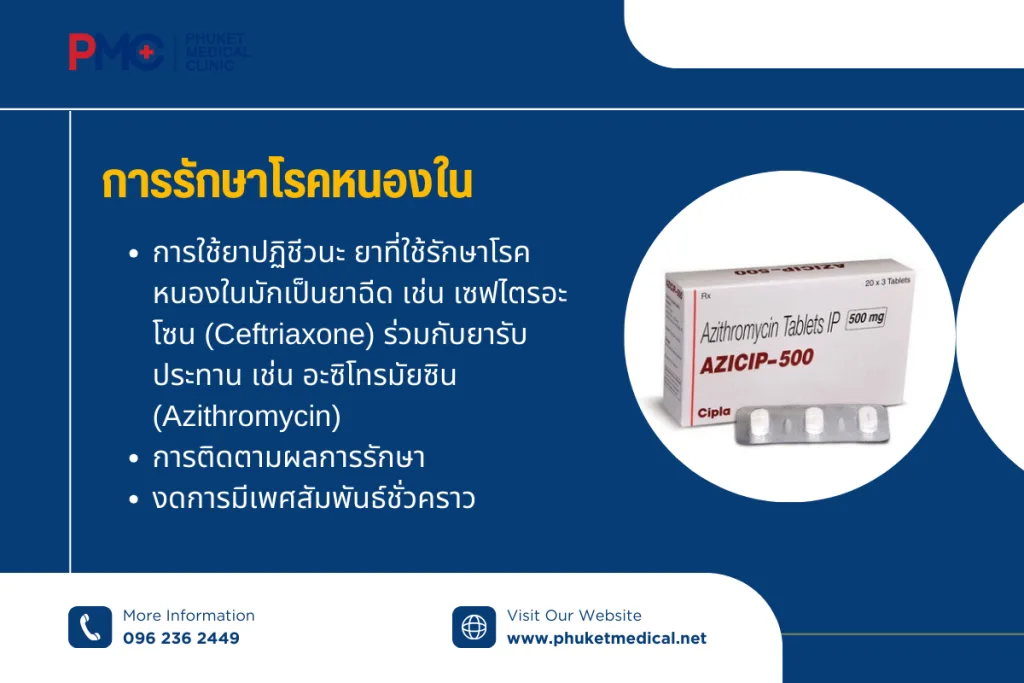
- Antibiotics: The drugs used to treat gonorrhea are usually injectable, such as Ceftriaxone, along with oral medications, such as Azithromycin.
- Follow-up treatment: After treatment, you should undergo a follow-up examination to confirm that the infection is completely cured.
- Abstain from sex temporarily. Abstain from sex until it is confirmed that you are completely cured, and you should bring your partner to be treated with you to reduce the risk of re-infection.
Gonorrhea Prevention
- Using a condom every time you have sex is a highly effective way to reduce the risk of infection.
- Avoid having multiple partners. Having only one partner reduces the chances of infection.
- Have regular sexual health check-ups. Screening helps detect the disease in its early stages.
- Avoid having sex when you have abnormal symptoms, such as abnormal vaginal discharge or burning when urinating.
Gonorrhea screening at Phuket Medical Clinic, Laguna Branch
Phuket Medical Clinic, Laguna Branch provides diagnosis and treatment for gonorrhea, a sexually transmitted disease that can occur in both men and women, with safe treatment standards and a team of specialized doctors.
Diagnostic Procedures
- History taking and risk assessment of sexually transmitted diseases
- Collect samples of secretions from the urethra, cervix, rectum or mouth
- Urine test or PCR test to confirm infection
- Recommend treatment guidelines and provide advice on disease prevention
Why should I get a gonorrhea test at Phuket Medical Clinic, Laguna branch?
- A team of doctors specializing in sexually transmitted diseases
- Accurate and private diagnosis
- Standard and safe treatment guidelines
- Provide advice on prevention and risk reduction of sexually transmitted diseases
If you suspect that you have gonorrhea or are at risk, you should get tested as soon as possible. Contact Phuket Medical Clinic, Laguna branch for consultation and services.
Read more articles
- Sexually Transmitted Disease Testing Reduce Risk Increase Confidence
- Sexually Transmitted Diseases Information Everyone Should Know for Safety
Contact Channels
Laguna Branch
- Phuket Medical Clinic, Laguna Branch is located at 58/1, Cherngtalay Subdistrict, Thalang District, Phuket Province 83100
- Open every day, Monday – Sunday, 09.00 – 22.00 hrs.
- Inquire via Line id. @pmcphuket (with @)
- Contact number 096 236 2449
- Clinic map https://maps.app.goo.gl/SXaeLrSU9Lx47YPH6
- Book an appointment online https://pmclaguna.youcanbook.me
Branch in the city
- Phuket Medical Clinic, Phuket City Branch is located at 41/7-41/8, Talat Nuea Subdistrict, Mueang Phuket District, Phuket Province 83000
- Open every day, Monday – Sunday, 09.00 – 22.00 hrs.
- Inquire via Line id. @pmcphuket (with @)
- Contact number 096 228 2449
- Clinic map https://maps.app.goo.gl/yeU9qNArGg3qdwZw9
- Book an appointment online https://phuketmedicalclinic.youcanbook.me
Boat Lagoon Branch
- Phuket Medical Clinic Boat Lagoon Branch is located at 20/96. Moo 2, Thepkrasattri Rd., Koh Kaew Subdistrict, Mueang Phuket District, Phuket Province 83000
- Open every day, Monday – Sunday, 10.00 – 18.00 hrs.
- Inquire via Line ID. @pmcphuket (with @)
- Contact number 096 696 2449
- Clinic map https://maps.app.goo.gl/HbqfUKMEHXuKwan96
- Book an appointment online https://pmctown.youcanbook.me
Gonorrhea is a curable STD if diagnosed and treated properly. Watching for warning signs, such as burning when urinating or unusual pus, is important to prevent the disease from spreading. Using condoms, getting regular sexual health checkups, and following your doctor’s advice can help reduce your risk and keep you healthy in the long run!
Refernce
- Centers for Disease Control and Prevention (CDC). (2023). Gonorrhea – CDC Fact Sheet (Detailed). [ออนไลน์] เข้าถึงได้จาก: https://www.cdc.gov/std/gonorrhea
- World Health Organization (WHO). (2023). Sexually Transmitted Infections (STIs) – Gonorrhea Fact Sheet. [ออนไลน์] เข้าถึงได้จาก: https://www.who.int/health-topics/gonorrhea
- Thai Red Cross AIDS Research Centre. (2023). การป้องกันและจัดการโรคหนองในในกลุ่มเสี่ยงสูง. [ออนไลน์] เข้าถึงได้จาก: https://www.trcarc.org
- กระทรวงสาธารณสุขแห่งประเทศไทย. (2023). แนวทางการวินิจฉัยและรักษาโรคติดต่อทางเพศสัมพันธ์ในประเทศไทย. [ออนไลน์] เข้าถึงได้จาก: http://www.ddc.moph.go.th
- สมาคมโรคติดต่อทางเพศสัมพันธ์แห่งประเทศไทย. (2023). แนวทางเวชปฏิบัติในการรักษาโรคหนองใน. [ออนไลน์] เข้าถึงได้จาก: https://www.thaistd.org