
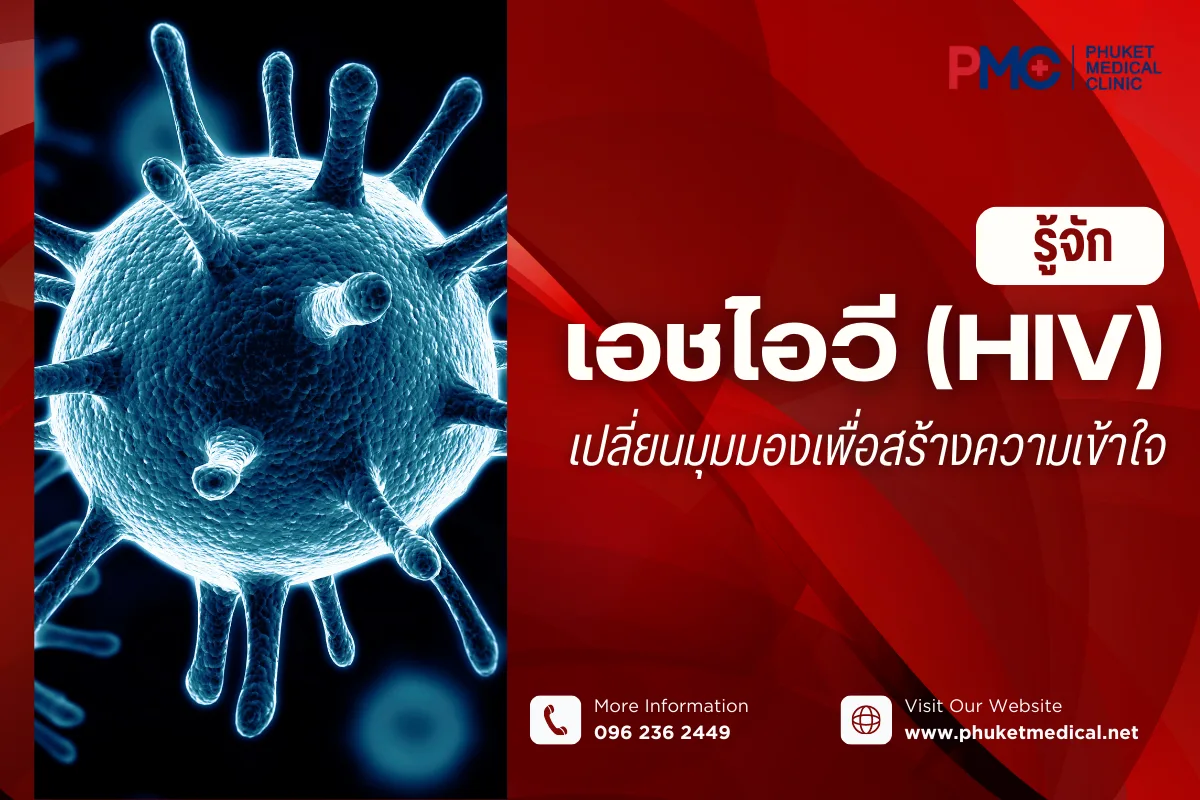
Knowing HIV is a term that many people may have heard, but there are still many misunderstandings and fears about this disease in society. With the development of medical technology, accurate knowledge about HIV can help us look at this disease more objectively, and support living together in society equally and safely.
Know what is HIV?
HIV (Human Immunodeficiency Virus) is a virus that affects the body’s immune system, especially CD4 white blood cells, which are responsible for fighting germs. When CD4 cells are reduced, the immune system will be weaker, making the body more susceptible to infections and complications. If left untreated in the long term, HIV can develop into AIDS, a condition in which the immune system fails completely.
HIV can be transmitted through:
- Unprotected sex, including vaginal, anal, and oral sex, if there is contact with fluids that contain HIV, such as semen, lubricant, and blood.
- Sharing needles or injection equipment, such as among drug users.
- Blood transfusions or organ transplants that are contaminated with the virus. Currently, the chances of this happening are very low because there is strict monitoring.
- Transmission from mother to child through pregnancy, childbirth, or breastfeeding.
HIV cannot be transmitted through:
- General contact, such as hugging, shaking hands, sharing objects.
- Coughing or sneezing.
- Sharing bathrooms or containers.
- Sharing food or water.
Symptoms of HIV infection
- Acute HIV Infection
- Fever
- Sore throat
- Muscle and joint pain
- Rash
- Swollen lymph nodes
- Clinical Latency Stage
- During this stage, infected people may have no symptoms or only have minor symptoms.
- AIDS
- Severe weight loss
- Tired easily
- Opportunistic infections such as tuberculosis, pneumonia
HIV testing
HIV testing can be done in the following ways:
- Antibody test: Tests for immunity that the body produces to fight the infection.
- Antigen/Antibody test: Tests for infection in the early stages when there are no antibodies.
- RNA test: Tests for HIV directly, suitable for people who are at risk of infection for a short time.
HIV Treatment
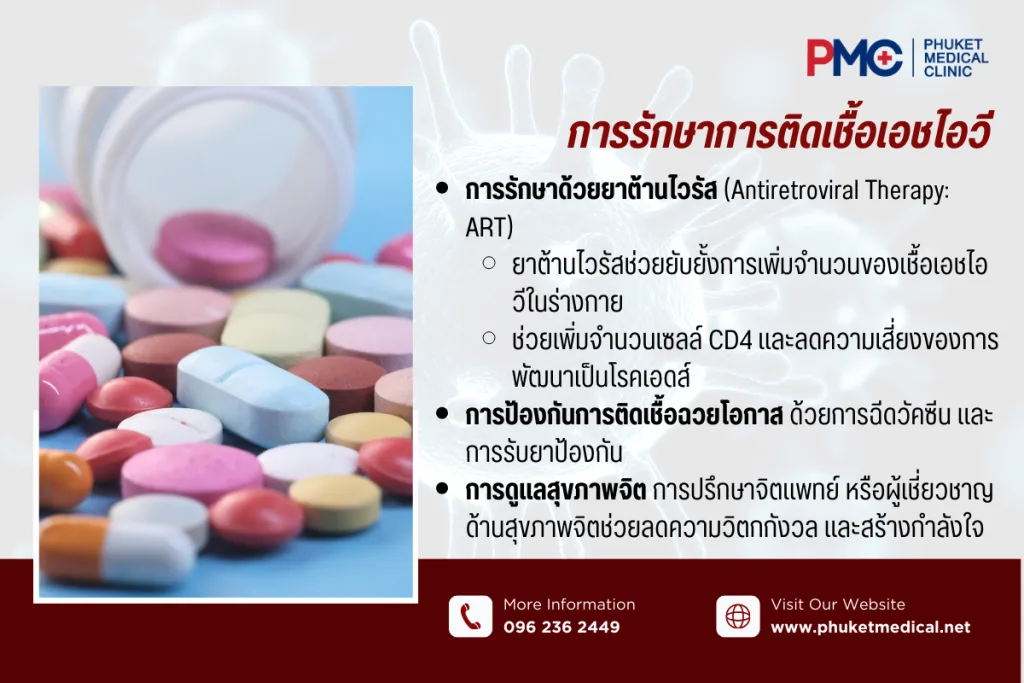
- Antiretroviral Therapy (ART)
- Antiretroviral drugs help stop the growth of HIV in the body.
- Increase the number of CD4 cells and reduce the risk of developing AIDS.
- Preventing opportunistic infections through vaccination and taking preventive medicine.
- Taking care of your mental health, consulting a psychiatrist or mental health professional can reduce anxiety and build morale.
Preventing HIV infection
- Using condoms during sex is a highly effective way to reduce the risk of HIV infection.
- Using PrEP for people at high risk of HIV infection, such as those with HIV-infected partners.
- Using PEP for emergencies after possible exposure to HIV.
- Avoiding sharing needles, using clean and private injection equipment.
- Annual health check-ups, HIV testing can detect the infection early and start treatment immediately.
Changing perspectives on people infected with HIV.
In Thai society, there is still prejudice and fear towards people infected with HIV, which mostly comes from misunderstanding and incorrect information. Changing perspectives is important to help people infected with HIV have a good quality of life and be able to live normally with people in society.
Facts to Know
- U=U (Undetectable = Untransmittable) People who are on antiretroviral (ARV) therapy and have a low viral load in their body that is undetectable will not be able to transmit the virus.
- ARV therapy can help people with HIV live longer and be healthier if diagnosed and treated promptly.
HIV Testing at Phuket Medical Clinic, Laguna Branch
Phuket Medical Clinic, Laguna Branch offers safe, accurate and private HIV testing with state-of-the-art medical equipment and a team of expert doctors who areร้อมให้คำปรึกษาและดูแลคุณในทุกขั้นตอน
HIV Testing Services at Phuket Medical Clinic, Laguna Branch
- Rapid HIV Test: Results within 15-30 minutes using a fingertip blood sample
- NAT (Nucleic Acid Test) HIV Test: detects infection as early as 7-10 days after infection, more accurate than general testing
- Pre- and post-test counseling: doctors and specialists provide advice on health care
HIV Test Procedures
- Register and receive consultation from a specialist
- Blood test using safe and modern techniques
- Wait for test results within 15-30 minutes (in the case of Rapid Test)
- Receive consultation after the test and health care guidelines
What should I do if the test result is positive?
- Start antiretroviral (ARV) drugs immediately – helps control the amount of virus in the body
- Prevent the spread of infection – use condoms and follow medical advice
- Live a normal life – good treatment helps infected people stay healthy
Phuket Medical Clinic Laguna Branch is pleased to serve you ✔ Safe ✔ Private ✔ International Standards Make an appointment for HIV testing today for your good health!
Read more articles
- Open your mind to HIV testing. Know early. Treat. Prevent.
- Sexually transmitted disease testing. Reduce risk. Increase confidence.
Contact Channels
Laguna Branch
- Phuket Medical Clinic, Laguna Branch is located at 58/1, Cherngtalay Subdistrict, Thalang District, Phuket Province 83100
- Open every day, Monday – Sunday, 09.00 – 22.00 hrs.
- Inquire via Line id. @pmcphuket (with @)
- Contact number 096 236 2449
- Clinic map https://maps.app.goo.gl/SXaeLrSU9Lx47YPH6
- Book an appointment online https://pmclaguna.youcanbook.me
Branch in the city
- Phuket Medical Clinic, Phuket City Branch is located at 41/7-41/8, Talat Nuea Subdistrict, Mueang Phuket District, Phuket Province 83000
- Open every day, Monday – Sunday, 09.00 – 22.00 hrs.
- Inquire via Line id. @pmcphuket (with @)
- Contact number 096 228 2449
- Clinic map https://maps.app.goo.gl/yeU9qNArGg3qdwZw9
- Book an appointment online https://phuketmedicalclinic.youcanbook.me
Boat Lagoon Branch
- Phuket Medical Clinic Boat Lagoon Branch is located at 20/96. Moo 2, Thepkrasattri Rd., Koh Kaew Subdistrict, Mueang Phuket District, Phuket Province 83000
- Open every day, Monday – Sunday, 10.00 – 18.00 hrs.
- Inquire via Line ID. @pmcphuket (with @)
- Contact number 096 696 2449
- Clinic map https://maps.app.goo.gl/HbqfUKMEHXuKwan96
- Book an appointment online https://pmctown.youcanbook.me
Knowing HIV is not a scary disease and it is not a disease that makes those infected lose the chance to have a good life. It just requires continuous treatment and care. Currently, those infected can have a long and healthy life like everyone else. Creating correct understanding and accepting the diversity of society is therefore important in reducing the spread and stigmatization of those infected with HIV. If you or someone close to you is at risk of HIV infection, you should get tested and consult with a specialist immediately because good health starts with proper attention and care from today!
Reference
- Centers for Disease Control and Prevention (CDC). HIV Basics. Comprehensive details on HIV transmission, prevention, and treatment. [ออนไลน์] เข้าถึงได้จาก https://www.cdc.gov/hiv/basics/index.html
- World Health Organization (WHO). Consolidated Guidelines on HIV Prevention, Testing, Treatment, Service Delivery, and Monitoring: Recommendations for a Public Health Approach. [ออนไลน์] เข้าถึงได้จาก https://www.who.int/publications/i/item/9789240031593
- กระทรวงสาธารณสุขแห่งประเทศไทย. เว็บไซต์ กรมควบคุมโรค กระทรวงสาธารณสุข. ข้อมูลเกี่ยวกับเอชไอวี/เอดส์ และแนวทางการรักษาในประเทศไทย. [ออนไลน์] เข้าถึงได้จาก https://ddc.moph.go.th/disease_detail.php?d=24
- สถาบันบำราศนราดูร. ข้อมูลการรักษาและป้องกันการติดเชื้อเอชไอวี รวมถึงบริการด้านเอชไอวีในประเทศไทย. [ออนไลน์] เข้าถึงได้จาก http://www.bamras.org/index.php/th/services/hiv-clinic
- มูลนิธิเอดส์แห่งประเทศไทย (Thai Red Cross AIDS Research Centre). รายละเอียดเกี่ยวกับการใช้ PrEP และบริการป้องกันการติดเชื้อเอชไอวี. [ออนไลน์] เข้าถึงได้จาก https://www.trcarc.org/th/prep