
Sexually transmitted diseases (STDs) are a major health problem that can affect anyone, male or female, at any age. Understanding these diseases is very important because it not only helps prevent the spread, but also reduces social stigma and increases awareness about sexual health. Being aware and following the correct prevention methods can help create safety in our lives and those around us.
What are STIs?
Sexually Transmitted Infections (STIs) are a group of diseases that can be spread from one person to another through sexual intercourse. They can be transmitted through vaginal, anal, and oral sex. They are caused by a variety of pathogens, such as bacteria, viruses, parasites, or fungi, and can affect various organs in the body, as well as overall health.
STIs are a global public health problem that affects not only physical health, but also mental health, personal relationships, and quality of life. Understanding STIs is an important step in preventing and reducing their spread.
Ways of Transmission of STDs
STDs are spread in several ways, including:
- Unprotected sex
- Through bodily fluids, such as semen, vaginal fluid, or blood
- Contact with sores or bumps on the genitals
- Skin-to-skin contact Some diseases, such as genital warts or herpes, can be transmitted only through skin-to-skin contact
- Sharing needles for injection, especially among drug users. Diseases such as HIV and hepatitis can be spread through contaminated needles
- From mother to child Some diseases, such as syphilis or HIV, can be passed from mother to child during pregnancy, childbirth, or breastfeeding
- Blood transfusions or organ transplants, although this is rare today because of strict monitoring
Types of STDs
STDs are caused by a variety of germs, including:
- Bacteria
- Examples: Gonorrhea, non-gonococcal urethritis, syphilis
- Can be cured with antibiotics if treated properly
- Viruses
- Examples: HIV, herpes simplex virus (HSV), genital warts (HPV), and hepatitis B and C
- Some viral infections, such as genital herpes and HIV, cannot be cured, but their symptoms can be managed with antiviral medications.
- Parasites
- Example: Trichomoniasis
- Often cause itching or irritation, and can be treated with medication.
- Fungal infections
- Example: Vaginal yeast infections
- Often cause by an imbalance in the vagina, and can be treated with antifungal medications.
Symptoms of STDs
STDs may have obvious symptoms or no symptoms at all. Symptoms often include:
- Blisters, sores, or lumps on the genitals
- Burning or painful urination
- Unusual vaginal discharge that is foul-smelling or yellow-green
- Itching or irritation in the genitals
- Pelvic pain
In some cases, especially in the early stages of infection, STDs may not have obvious symptoms. Regular checkups are important to detect and treat the infection early.ต่ระยะแรก
Treatment of STDs
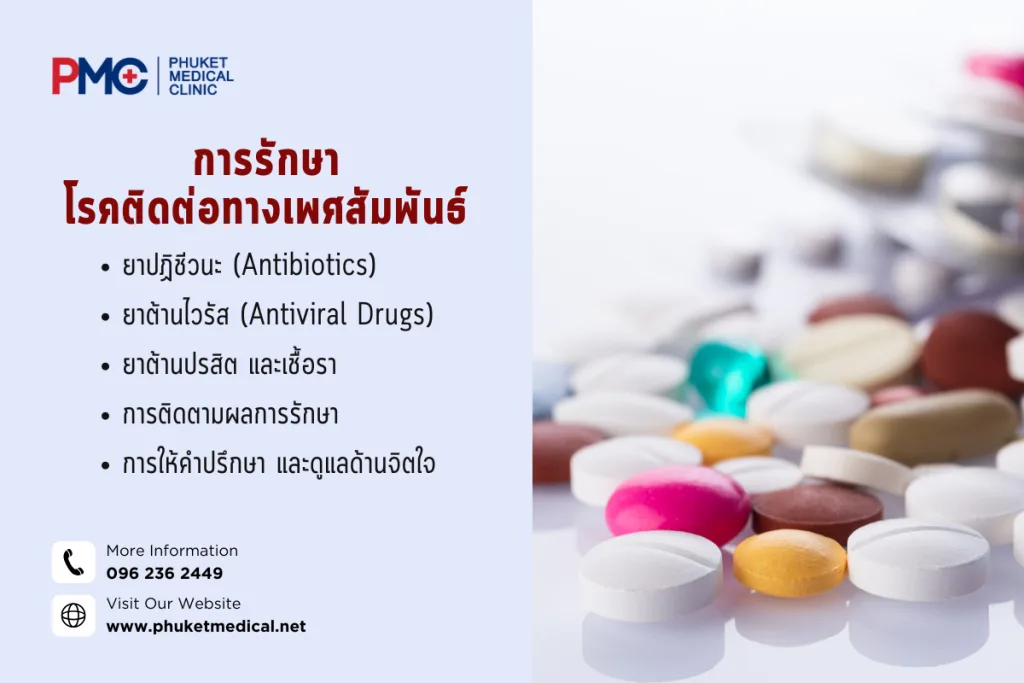
Treatment of STDs depends on the type of pathogen that is causing the infection. Here are some of the methods:
- Antibiotics
- For bacterial infections, such as gonorrhea, chlamydia, and syphilis.
- Taking antibiotics correctly and as prescribed by your doctor can help cure the infection.
- Antiviral Drugs
- For viral infections, such as genital herpes and HIV.
- They help reduce the spread of the infection and control symptoms, but they do not eliminate the infection from the body.
- Antiparasitic and antifungal drugs
- For parasitic infections, such as vaginal thrush or yeast infections.
- These drugs help relieve symptoms and eliminate the infection from the body.
- Follow-up treatment
- Patients should be tested again after treatment to confirm that the infection has been completely eliminated.
- It is also important to test the patient’s sexual partners to prevent re-infection.
- Counseling and psychological supportSTDs can affect mental health.
- Consulting a professional can help patients cope better with this problem.
Prevention of STDs
- Using condoms is a highly effective method of prevention, reducing the risk of bacterial and viral infections.
- Regular health check-ups Screening helps detect diseases early and reduce the spread to others.
- Avoid having multiple partners. Reducing the number of sexual partners reduces the risk of infection.
- Get vaccinated. The HPV and hepatitis B vaccines reduce the risk of certain diseases.
- Educate yourself about sex. Talking openly about sexual health helps promote prevention and reduces the embarrassment of seeking advice.
Sexually Transmitted Disease Testing at Phuket Medical Clinic, Laguna Branch
Phuket Medical Clinic, Laguna Branch provides comprehensive diagnostic and treatment services for sexually transmitted diseases with a team of specialist doctors and modern technology. We are ready to provide consultation and detailed care at every step for the safety and good health of you and your partner.
Reasons to get tested for STDs at Phuket Medical Clinic, Laguna
- Privacy Every step of the service is conducted with the utmost privacy.
- A team of expert doctors with specialized doctors who have experience in STDs.
- Comprehensive treatment, not only diagnosis, but also treatment and appropriate advice.
- Modern equipment and technology, using accurate and safe diagnostic technology.
Phuket Medical Clinic, Laguna Branch is ready to provide STD testing with care and international standards to ensure your sexual health and that of your loved ones.รัก.
Read more articles
- Sexually Transmitted Disease Tests Reduce Risk, Increase Confidence
- Specialized Health Checkups Deep Health Checkups for Long Life
Contact Channels
Laguna Branch
- Phuket Medical Clinic, Laguna Branch is located at 58/1, Cherngtalay Subdistrict, Thalang District, Phuket Province 83100
- Open every day, Monday – Sunday, 09.00 – 22.00 hrs.
- Inquire via Line id. @pmcphuket (with @)
- Contact number 096 236 2449
- Clinic map https://maps.app.goo.gl/SXaeLrSU9Lx47YPH6
- Book an appointment online https://pmclaguna.youcanbook.me
Branch in the city
- Phuket Medical Clinic, Phuket City Branch is located at 41/7-41/8, Talat Nuea Subdistrict, Mueang Phuket District, Phuket Province 83000
- Open every day, Monday – Sunday, 09.00 – 22.00 hrs.
- Inquire via Line id. @pmcphuket (with @)
- Contact number 096 228 2449
- Clinic map https://maps.app.goo.gl/yeU9qNArGg3qdwZw9
- Book an appointment online https://phuketmedicalclinic.youcanbook.me
Boat Lagoon Branch
- Phuket Medical Clinic Boat Lagoon Branch is located at 20/96. Moo 2, Thepkrasattri Rd., Koh Kaew Subdistrict, Mueang Phuket District, Phuket Province 83000
- Open every day, Monday – Sunday, 10.00 – 18.00 hrs.
- Inquire via Line ID. @pmcphuket (with @)
- Contact number 096 696 2449
- Clinic map https://maps.app.goo.gl/HbqfUKMEHXuKwan96
- Book an appointment online https://pmctown.youcanbook.me
Sexually transmitted diseases are a major health problem and can be prevented. Knowing the characteristics, methods of transmission and prevention are important in reducing the risk. Having health screenings and talking openly with your partner can increase safety and quality of life in the long run because good sexual health is part of having a healthy and happy life!
Reference
- Centers for Disease Control and Prevention (CDC). Sexually Transmitted Infections (STIs). Comprehensive details on STIs, their prevention, and treatment. [ออนไลน์] เข้าถึงได้จาก https://www.cdc.gov/std
- World Health Organization (WHO). Sexually Transmitted Infections (STIs). Global guidelines on the prevention, diagnosis, and treatment of STIs. [ออนไลน์] เข้าถึงได้จาก https://www.who.int/news-room/fact-sheets/detail/sexually-transmitted-infections-(stis)
- กระทรวงสาธารณสุขแห่งประเทศไทย. เว็บไซต์ กรมควบคุมโรค กระทรวงสาธารณสุข. ข้อมูลเกี่ยวกับโรคติดต่อทางเพศสัมพันธ์ในประเทศไทย. [ออนไลน์] เข้าถึงได้จาก https://ddc.moph.go.th/disease_detail.php?d=24
- สถาบันบำราศนราดูร. ข้อมูลการตรวจวินิจฉัยและรักษาโรคติดต่อทางเพศสัมพันธ์. [ออนไลน์] เข้าถึงได้จาก http://www.bamras.org
- มูลนิธิเลิฟฟาวเดชั่น (Love Foundation). ความสำคัญของการศึกษาและการป้องกันโรคติดต่อทางเพศสัมพันธ์. [ออนไลน์] เข้าถึงได้จาก https://lovefoundation.or.th