
HIV (human immunodeficiency virus) is a disease of global public health importance because this virus attacks the body’s immune system, especially white blood cells (CD4), which are an important mechanism for protecting against germs. If the infection is left untreated, infected people are at high risk of developing opportunistic infections and may develop into AIDS or end-stage immunodeficiency.
Currently, although HIV cannot be completely cured, medical advances, especially in the area of antiretroviral drugs, have helped infected people live a quality life, reduce the chances of spreading the infection, and effectively control the amount of virus in the body.
What is HIV?
HIV (Human Immunodeficiency Virus) is a type of virus that directly affects the body’s immune system. This virus destroys CD4 white blood cells, which are cells that have an important role in protecting against various germs. When white blood cells are continuously destroyed, the body will become weaker and unable to resist germs or opportunistic infections. This makes people with HIV at risk of contracting infectious diseases that normal people do not easily contract, or may eventually develop into AIDS.
What causes HIV?
HIV is caused by a virus called the Human Immunodeficiency Virus, which can be spread through:
- Unprotected sex, especially vaginal, anal, and oral sex
- Sharing needles, such as in groups of injecting drug users
- Receiving contaminated blood
- Transmission from mother to child through pregnancy, childbirth, or breastfeeding
What is the difference between HIV and AIDS?
Although HIV and AIDS are closely related, they are different:
- HIV is a virus that weakens the body’s immune system.
- AIDS, or acquired immunodeficiency syndrome, is the final stage of HIV infection. Which the body has low immunity until it causes severe complications
How are HIV and syphilis related?
HIV and syphilis are diseases that can occur together because both diseases are transmitted through sexual intercourse. And the wound from syphilis also increases the chances of HIV entering the body more easily. At the same time, HIV that weakens the immune system also increases the risk of contracting syphilis, as well as other sexually transmitted diseases such as
- Gonorrhea and non-gonorrhea
- Genital warts
- Channel sores
- Hepatitis B and C
How can HIV be transmitted?
HIV can be spread through
Unprotected sex (the most common route)
- Receiving contaminated blood
- Sharing injection needles, such as drug use
- Transmission from mother to child
- Contact with the blood or bodily fluids of an infected person, such as semen, lubricant, or blood
However, HIV is not transmitted through casual contact, such as shaking hands, hugging, or sharing bathrooms.
HIV Symptoms: Early to Late Stages
Acute HIV Infection
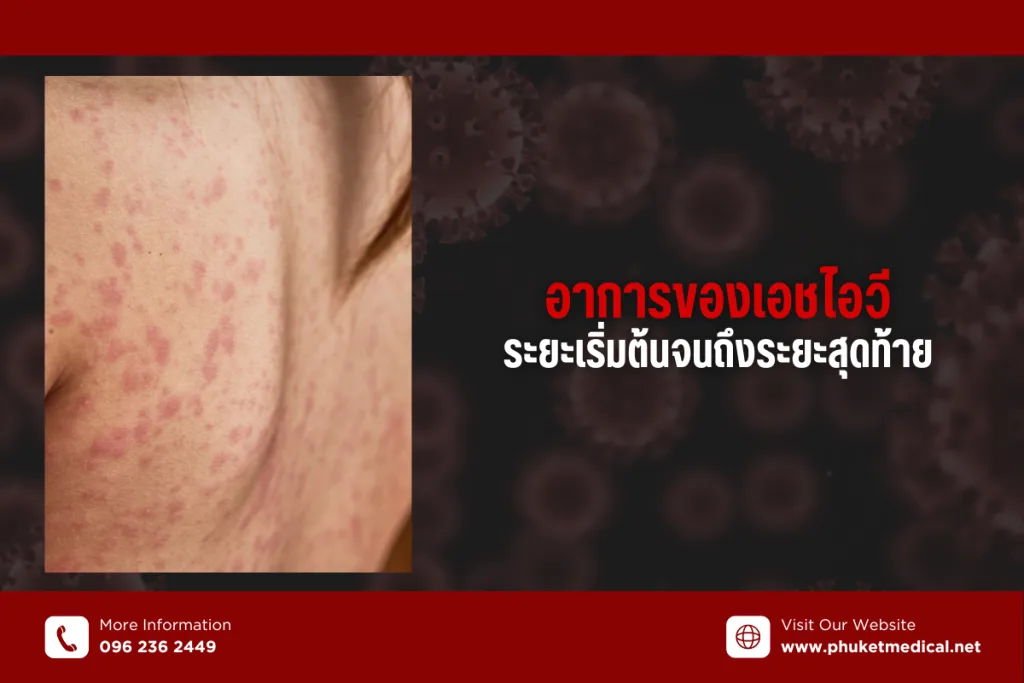
In the early stages of HIV infection, most patients do not show any obvious symptoms because the body can still produce white blood cells to deal with the virus to some extent. However, some patients may start to have flu-like symptoms that occur temporarily and then disappear on their own. Symptoms that may be found in the early stages include:
- Fever that comes and goes
- Headache
- Swollen lymph nodes
- Sore throat
- Red rash on the body
- Unexplained weight loss
During this period, HIV will start to enter the bloodstream and multiply rapidly. Testing for infection during this period will use detailed tests, such as testing for viral RNA.
Chronic HIV Infection
After the first stage has passed, the virus will enter a dormant stage, which can last for several years. During this period, most infected people may not have any symptoms, but the virus will continue to multiply in the body and gradually destroy white blood cells (CD4). If not treated with antiretroviral drugs, this stage may progress to the late stage.
Late HIV (AIDS)
The late stage of HIV infection Acquired Immunodeficiency Syndrome (AIDS) occurs when the body’s immune system is almost completely destroyed, leaving the patient at high risk of opportunistic infections and complications such as tuberculosis, pneumonia, or certain types of cancer. Common symptoms during this stage include:
- PPE (Pruritic Papular Eruption) bumps, which are caused by a very low immune system (CD4 cells are less than 200 cells/mm)
- Rapid weight loss
- Constant fatigue
- Fever and night sweats
- Opportunistic infections, such as oral or esophageal yeast infections
- Skin rashes or sores
Are HIV symptoms different in men and women?
HIV affects men and women in similar ways. Symptoms are generally similar in the early and late stages. However, some minor differences include:
In women
- Sexually transmitted infections, such as vaginal yeast infections or cervical inflammation, may occur more frequently.
- Mens’ menstrual cycles may be irregular due to weakness and hormonal changes.
In men
- Opportunistic infections of the genitals, such as a yeast infection on the tip of the penis, may occur.
- There is usually a rash or sores on the skin on the trunk or arms and legs.
- The time it takes for HIV to change to AIDS in each person
The length of time varies depending on the individual’s health and immune system. If left untreated, it can take anywhere from two to 20 years for HIV to progress to AIDS. However, with modern treatment and access to antiretroviral therapy (ART), people can live longer and have a quality of life that is close to that of a normal person.
HIV Blood Test: Importance and Reasons to Do It
HIV blood test is an important step to help us know our health status, especially for those who have risky behaviors or have frequent sex. Because HIV infection in the early stages often has no clear symptoms, many infected people do not know that they are infected. Regular blood tests can help us know our infection status from the beginning, which has the following advantages:
- Know your health status. If HIV is found in the early stages, it will allow you to start treatment immediately, reduce the chance of complications and maintain a strong immune system.
- Prevent the spread of infection. Those who know their infection status can prevent the spread of infection to others, such as strictly using condoms or following medical advice.
- Reduce the risk of unsafe behavior. Blood tests help increase awareness of the importance of protecting yourself from HIV and other sexually transmitted diseases.
Current HIV treatment methods
Although there is no cure for HIV, antiretroviral therapy (ART) is a highly effective option that helps reduce the amount of virus in the body to a level so low that it cannot be detected in the blood (Undetectable Viral Load), allowing
- patients to have a quality of life close to normal.
- The risk of spreading the virus to others is reduced to almost zero if the medication is taken strictly according to the doctor’s instructions.
ART treatment steps
- Start treatment: The doctor will prescribe the appropriate antiretroviral medication to start taking as soon as the infection is detected.
- Health monitoring: The patient must have regular blood tests to assess the viral load and CD4 white blood cell count.
- Take medication regularly: Missing a dose can cause the virus to become drug-resistant and reduce the effectiveness of the treatment.
Although there is no cure, continuing treatment will help patients live their normal lives and reduce the risk of complications from opportunistic infections.
HIV prevention: How to reduce the risk
- Use condoms correctly Using condoms during sex is a highly effective way to prevent HIV and other sexually transmitted diseases. However, it is important to choose quality condoms, check the expiration date, and use them correctly to prevent tearing.
- Use PrEP (Pre-Exposure Prophylaxis) PrEP is a drug used to prevent HIV infection for people who are not infected but are at high risk, such as couples where one person is infected with HIV. Using PrEP consistently can reduce the chance of infection by up to 99% when taken as recommended by the doctor.
- Avoid risky behaviors, such as avoiding sharing injection needles or avoiding unprotected sex.
- Masturbation and genital cleanliness Masturbation is a safe alternative and reduces the risk of HIV infection. Maintaining cleanliness in the genital area also helps prevent other sexually transmitted diseases, such as chickenpox and chlamydia.
- Oral sex Oral sex has a very low risk of HIV infection because the amount of HIV in saliva is too small to cause infection. However, if there is an open wound in the mouth or genitals, the risk may increase.
Frequently Asked Questions About HIV
Can HIV be Cured?
There is currently no cure for HIV in the general population. Current treatment focuses on controlling the amount of virus in the body to a minimum level through regular antiretroviral therapy (ART), which allows people with the virus to live a near-normal life and reduce the risk of spreading the virus to others.
However, there are reports of two people in the world who have been successfully cured of HIV through stem cell transplantation, a complex and high-risk procedure. This procedure was developed to treat cancers such as leukemia, not to directly treat HIV, and is not available for everyone. It also requires donors with stem cells who have specific immunity to HIV, which is very rare.
Conclusion: HIV is still a disease that requires ongoing treatment. People can live a normal life if they take good care of their health and take their medication as prescribed by their doctor.
Can I get a visa if I have HIV?
Visa restrictions for people with HIV vary depending on the policies of each country:
- Countries that accept people with HIV Many countries accept people with HIV, with certain conditions, such as showing evidence that the virus is under control, having health insurance that covers the cost of treatment, or having an appropriate health care plan.
- Countries with restrictions Some countries have strict restrictions and do not allow people with HIV to enter the country, such as countries that require healthy foreign workers or countries that have specific health requirements for visa applicants.
- Thailand Thailand has no restrictions on HIV testing for visa applications, so people with HIV can apply for a visa to enter Thailand without any problems.
Advice: Before traveling or applying for a visa, you should thoroughly study the policies of the destination country regarding people with HIV, or consult the embassy of that country for clarity.
HIV testing and treatment at Phuket Medical Clinic
Phuket Medical Clinic, Laguna branch, provides HIV testing and treatment in privacy and safety with a team of expert doctors and modern technology.
HIV testing services
- Rapid HIV test, get results in 1-2 hours
- Pre- and post-test consultation to help assess your risk and provide advice on health care
HIV treatment services
- Antiretroviral therapy (ART) to control the amount of virus in the body
- Regular monitoring of CD4 and Viral Load levels
- Prevent secondary infections and provide advice on using PrEP or PEP
Our strengths
- Privacy and safety
- Team of expert doctors and comprehensive care
- Testing technology And international standard treatment
Give yourself good health and confidence with effective HIV care and prevention at Phuket Medical Clinic.
Read more articles
- Is HIV testing necessary and where should I get tested?
- Preventive and emergency HIV medications: A detailed understanding and how to get them
Contact Channels
Laguna Branch
- Phuket Medical Clinic, Laguna Branch is located at 58/1, Cherngtalay Subdistrict, Thalang District, Phuket Province 83100
- Open every day, Monday – Sunday, 09.00 – 22.00 hrs.
- Inquire via Line id. @pmcphuket (with @)
- Contact number 096 236 2449
- Clinic map https://maps.app.goo.gl/SXaeLrSU9Lx47YPH6
- Book an appointment online https://pmclaguna.youcanbook.me
Branch in the city
- Phuket Medical Clinic, Phuket City Branch is located at 41/7-41/8, Talat Nuea Subdistrict, Mueang Phuket District, Phuket Province 83000
- Open every day, Monday – Sunday, 09.00 – 22.00 hrs.
- Inquire via Line id. @pmcphuket (with @)
- Contact number 096 228 2449
- Clinic map https://maps.app.goo.gl/yeU9qNArGg3qdwZw9
- Book an appointment online https://phuketmedicalclinic.youcanbook.me
Boat Lagoon Branch
- Phuket Medical Clinic Boat Lagoon Branch is located at 20/96. Moo 2, Thepkrasattri Rd., Koh Kaew Subdistrict, Mueang Phuket District, Phuket Province 83000
- Open every day, Monday – Sunday, 10.00 – 18.00 hrs.
- Inquire via Line ID. @pmcphuket (with @)
- Contact number 096 696 2449
- Clinic map https://maps.app.goo.gl/HbqfUKMEHXuKwan96
- Book an appointment online https://pmctown.youcanbook.me
HIV is a manageable disease if people with the disease are diagnosed and treated appropriately. Prevention with condoms, regular health check-ups, and taking antiretroviral drugs help people with the disease live normal lives and are safe from the spread of the disease. Therefore, HIV care and education in society are very important to reduce the spread of the disease and improve the quality of life of people with the disease.
Although HIV is not yet curable, with the current treatment and advanced technology, people with HIV can have a good and long-lasting quality of life. It is important to know your own health status and strictly follow your doctor’s advice. In addition, travel or visa requirements for people with HIV depend on the policies of each country, but many countries are currently open and do not have any restrictions on this matter.
Reference
- Centers for Disease Control and Prevention (CDC). HIV Basics: Overview of HIV/AIDS. [ออนไลน์] เข้าถึงได้จาก https://www.cdc.gov/hiv/basics/index.html
- World Health Organization (WHO). HIV/AIDS: Key facts and global guidelines. [ออนไลน์] เข้าถึงได้จาก https://www.who.int/news-room/fact-sheets/detail/hiv-aids
- UNAIDS. Global AIDS Update 2024: Key statistics and guidelines. [ออนไลน์] เข้าถึงได้จาก https://www.unaids.org
- สถาบันบำราศนราดูร. บริการตรวจและรักษาผู้ติดเชื้อเอชไอวีในประเทศไทย. [ออนไลน์] เข้าถึงได้จาก https://www.bamras.org
- มูลนิธิเอดส์แห่งประเทศไทย (Thai Red Cross AIDS Research Centre). แนวทางการดูแลผู้ติดเชื้อ HIV และการใช้ยา PrEP และ PEP. [ออนไลน์] เข้าถึงได้จาก https://www.trcarc.org