
Non-Chlamydia is a common sexually transmitted disease caused by infection with the bacterium Chlamydia trachomatis. The disease often has no symptoms in the early stages, but if not treated promptly, it can lead to serious complications such as infertility or inflammation in various organs. Understanding non-gonococcal urethritis and its effects on the body is important for prevention and treatment.
What is Non-Chlamydia?
Non-Chlamydia (Chlamydia trachomatis) is an infection of the bacteria Chlamydia trachomatis that affects the reproductive system and other organs through vaginal, anal, and oral sex. It can affect both men and women and can be passed from mother to child during childbirth.
Symptoms of Non-Chlamydia
In men
- Painful urination
- Pus or clear discharge from the tip of the penis
- Pain or swelling of the testicles
In women
- Unusual vaginal discharge (foul-smelling or discolored)
- Lower abdominal or back pain
- Painful urination
- Bleeding between periods or after sex
Symptoms in both men and women
- Throat infections: may or may not have symptoms or a sore throat
- Rectal infections: itching, pain, or bleeding
Complications of Non-Chlamydia
If left untreated, non-chlamydia can lead to serious complications, such as:
- Pelvic Inflammatory Disease (PID) occurs in women where the infection has spread to the uterus and ovaries, increasing the risk of infertility or ectopic pregnancy.
- Epididymitis occurs in men, causing pain and swelling in the testicles, leading to infertility.
- Trachoma: If exposed to the infection directly, the eye can become inflamed and cause loss of vision.
- Infections in newborns: Babies born to infected mothers may develop pneumonia or eye inflammation.
- Disseminated Chlamydial Infection: Infections in joints and other organs.
Diagnosing Non-Chlamydia
- A sample of bodily fluids, such as from the cervix, urethra, rectum, or throat, is collected.
- A urine test is used to diagnose urinary tract infections.
- A culture or DNA test is used to detect bacteria using the NAAT (Nucleic Acid Amplification Test).
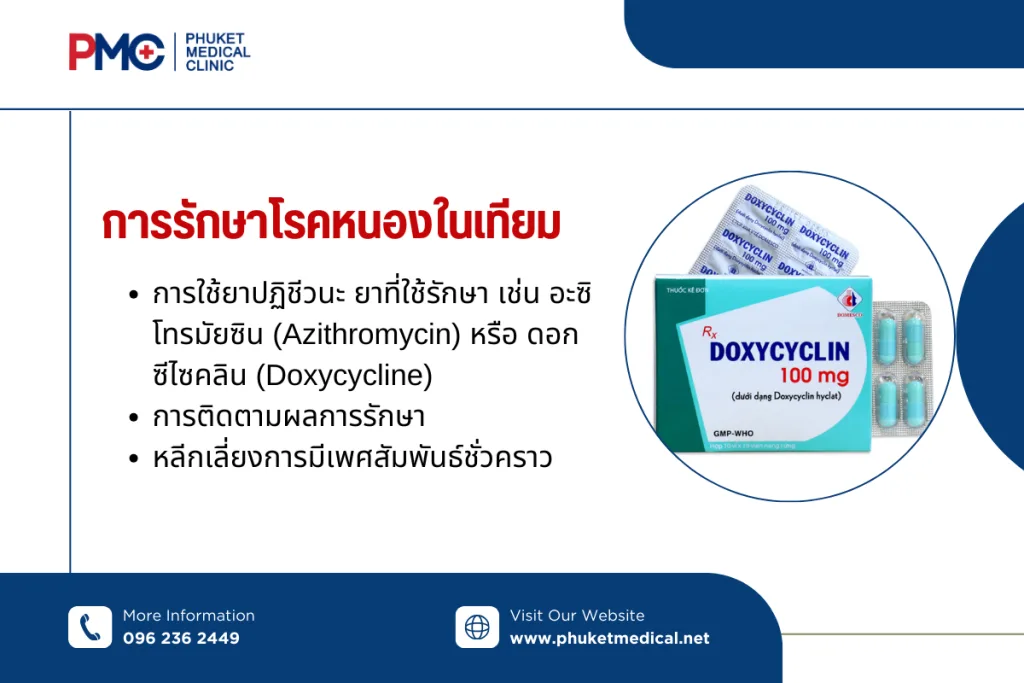
Treatment of non-gonococcal urethritis
- Antibiotics, medications such as azithromycin or doxycycline should be taken as prescribed by the doctor.
- Follow-up after treatment, repeat tests should be performed to confirm that the infection is completely cured.
- Avoid having sex temporarily. Abstain from sex until it is confirmed that you are completely cured. You should also take your sexual partner to receive treatment at the same time to prevent re-infection.
Prevention of non-gonococcal urethritis
- Use condoms every time you have sex. This is a highly effective method of prevention.
- Have regular sexual health check-ups, especially for those at risk, such as those with multiple partners.
- Avoid having multiple partners. Having only one partner reduces the chance of infection.
- Avoid contact with bodily fluids, such as pus or vaginal fluid.
- Get vaccinated. Although there is no specific vaccine for non-gonococcal urethritis, vaccinations for other related diseases, such as HPV, can reduce the overall risk.
Non-gonococcal urethritis screening at Phuket Medical Clinic, Laguna Branch
Phuket Medical Clinic, Laguna Branch provides diagnostic and treatment services for non-gonococcal urethritis (Chlamydia), a common sexually transmitted disease. Ready to take care of your health with modern medical standards
Diagnostic examination process
- Ask about your health history and risky behaviors
- Collect a sample of secretions from the cervix, urethra or rectum
- Urine test or PCR test to confirm the result
- Recommend treatment and provide sexual health consultation
Why do you need to get tested for non-gonococcal urethritis at Phuket Medical Clinic, Laguna branch?
- A team of doctors specializing in sexually transmitted diseases
- Fast, accurate and private diagnosis
- Standard treatment guidelines that are safe and reduce the chance of complications
- Provide advice on sexually transmitted disease prevention
If you suspect that you have a non-gonococcal urethritis infection or risky behavior, you should get tested as soon as possible. Contact Phuket Medical Clinic, Laguna branch for consultation and treatment
Read more articles
- Sexually Transmitted Diseases: Information Everyone Should Know for Safety
- Warning Signs of Gonorrhea: Know Before It Spreads
Contact Channels
Laguna Branch
- Phuket Medical Clinic, Laguna Branch is located at 58/1, Cherngtalay Subdistrict, Thalang District, Phuket Province 83100
- Open every day, Monday – Sunday, 09.00 – 22.00 hrs.
- Inquire via Line id. @pmcphuket (with @)
- Contact number 096 236 2449
- Clinic map https://maps.app.goo.gl/SXaeLrSU9Lx47YPH6
- Book an appointment online https://pmclaguna.youcanbook.me
Branch in the city
- Phuket Medical Clinic, Phuket City Branch is located at 41/7-41/8, Talat Nuea Subdistrict, Mueang Phuket District, Phuket Province 83000
- Open every day, Monday – Sunday, 09.00 – 22.00 hrs.
- Inquire via Line id. @pmcphuket (with @)
- Contact number 096 228 2449
- Clinic map https://maps.app.goo.gl/yeU9qNArGg3qdwZw9
- Book an appointment online https://phuketmedicalclinic.youcanbook.me
Boat Lagoon Branch
- Phuket Medical Clinic Boat Lagoon Branch is located at 20/96. Moo 2, Thepkrasattri Rd., Koh Kaew Subdistrict, Mueang Phuket District, Phuket Province 83000
- Open every day, Monday – Sunday, 10.00 – 18.00 hrs.
- Inquire via Line ID. @pmcphuket (with @)
- Contact number 096 696 2449
- Clinic map https://maps.app.goo.gl/HbqfUKMEHXuKwan96
- Book an appointment online https://pmctown.youcanbook.me
Non-gonococcal urethritis is a curable sexually transmitted disease if diagnosed and treated properly. Monitoring your symptoms and getting regular sexual health checkups can reduce your risk of complications. Prevention by using condoms and following medical advice are the keys to maintaining your health and that of those around you. Good health starts with taking responsibility for yourself!
Reference
- Centers for Disease Control and Prevention (CDC). (2023). Chlamydia – CDC Fact Sheet. [ออนไลน์] เข้าถึงได้จาก: https://www.cdc.gov
- World Health Organization (WHO). (2023). Chlamydia: Key Facts and Prevention Strategies. [ออนไลน์] เข้าถึงได้จาก: https://www.who.int
- Mayo Clinic. (2023). Chlamydia Infection – Symptoms and Causes. [ออนไลน์] เข้าถึงได้จาก: https://www.mayoclinic.org
- กระทรวงสาธารณสุขแห่งประเทศไทย. (2023). แนวทางการวินิจฉัยและรักษาโรคหนองในเทียมในประเทศไทย. [ออนไลน์] เข้าถึงได้จาก: http://www.ddc.moph.go.th
- สถาบันบำราศนราดูร. (2023). โรคติดต่อทางเพศสัมพันธ์: การวินิจฉัยและแนวทางรักษาโรคหนองในเทียม. [ออนไลน์] เข้าถึงได้จาก: https://www.bamras.org